
Beyond the City of Nawabs: 5 Surprising Ways Lucknow’s Airport is Redefining Global Travel
- Total Investment on Airport (Terminal 3): ₹2,400 crore
- Current Capacity (T3 Phase 1): 8 Million Passengers Per Annum (MPPA)
- Future Capacity Goal: 39 MPPA
- Runway Expansion: From 2,744m to 3,500m
- Technical Distinction: First airport globally to achieve the BSI BIM Kitemark for Design and Construction
The Gateway to the Future of Awadh
For centuries, Lucknow has been the soul of North Indian refinement—a city where the slow-paced elegance of tehzeeb (etiquette) meets the intricate threads of Chikankari embroidery. Yet, at the southern edge of this heritage-rich capital, the “City of Nawabs” is quietly engineering a radical departure from the traditional. The Chaudhary Charan Singh International Airport (CCSIA) is no longer a mere regional stopover; it is being meticulously choreographed as a high-tech gateway that challenges the dominance of India’s traditional aviation hubs.
With the inauguration of the ₹2,400 crore Terminal 3 (T3), CCSIA has transitioned into a multimodal marvel where 18th-century artistry meets 21st-century infrastructure. How does a Tier-2 city bypass the conventional hub-and-spoke model to become a global standard? The answer lies in a sophisticated synergy of cultural identity and industrial ambition.
Architecture with a Soul: A Narrative Choreography of Space

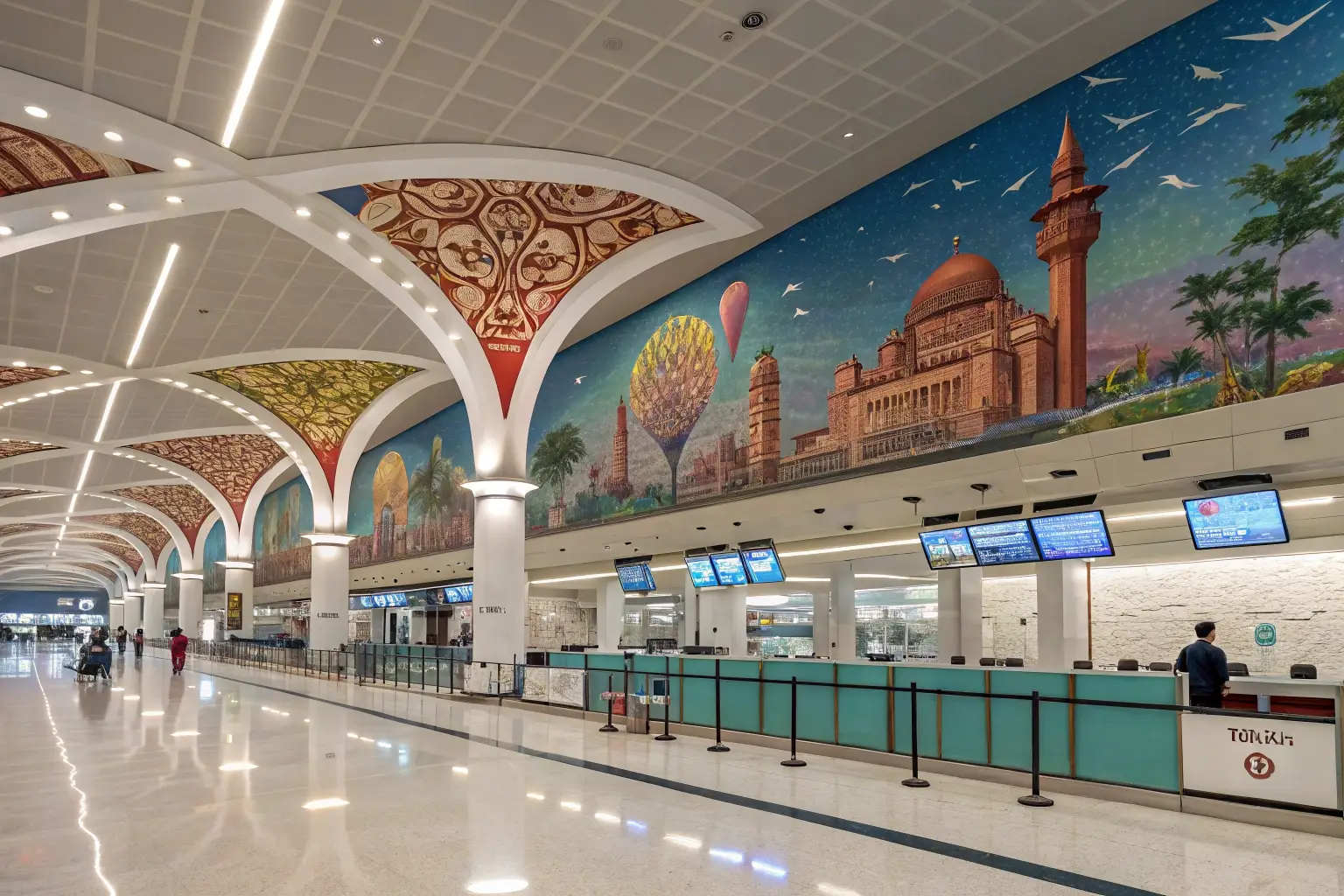
While modern international terminals often succumb to the sterility of glass-and-steel minimalism, Terminal 3 utilizes a distinct visual vocabulary to ensure it is never “just a transit space.” The architecture is a curated journey through the Ganga-Jamuni tehzeeb—the syncretic cultural fusion of the region.
The passenger journey begins at three dedicated entry points that narrate the Nawabi lifestyle through motifs of chess, the fluid grace of Kathak dance, and the musical jugalbandi of the sitar and tabla. Inside, the “soul” of the terminal is found in the details:
- Illuminated Craft: Check-in counters are mesmerically lit with patterns of Chikankari and Mukaish metal embroidery.
- Prosperity in the Skies: Looking upward, passengers see massive skylights shaped like fish—the state emblem of Uttar Pradesh and a symbol of prosperity—integrated into a 3D ceiling that mimics rippling water.
- The Cultural Jhanki: A stunning 40-meter mural titled “Uttar Pradesh Ki Jhanki” utilizes Khadi, Velvet, and Tanchoi silk to depict the state’s iconic landmarks, from the Rumi Darwaza to the Taj Mahal.
- The Floral Passage: Leading to the boarding gates, a “Basant Panchami” themed passage uses hand-blown glass from Firozabad to mimic a field of flowers, transforming a mundane walk into a sensory experience.
The “Frankfurt of India”: European Efficiency in the Heart of UP
The technical DNA of Terminal 3 is rooted in a partnership with the British architectural firm Pascall+Watson and project management by Egis. The “Frankfurt” comparison isn’t merely marketing—it refers to the specific design philosophy of an integrated terminal. By handling both domestic and international traffic under one cohesive roof, the terminal achieves the seamless operational efficiency of major European hubs.
World-Class Tech Infrastructure:
- DigiYatra: Biometric-based, paperless entry for a touchless journey.
- E-Gates & 2D Scanners: Precision security that eliminates traditional bottlenecks.
- Automatic Tray Retrieval System (ATRS): High-speed handbag scanning that significantly reduces wait times.
- ANPR System: Automatic Number-Plate Recognition and FasTag-based payments for seamless vehicular flow.
As one of only six airports in India equipped with ILS CAT IIIB capability, Lucknow can facilitate safe landings in visibility as low as 50 meters, ensuring global-grade reliability even during Northern India’s notorious winter fogs.
The 3,500-Meter Ambition: Bypassing the Hub-and-Spoke Model
In the world of aviation strategy, runway length equals economic reach. CCSIA is currently undertaking an ambitious project to extend its runway from 2,744 meters to 3,500 meters. This is not merely an upgrade; it is a declaration of independence from traditional hubs like Delhi or Mumbai.
This expansion allows the airport to accommodate fuel-laden, wide-body aircraft—specifically the Airbus A350 and Boeing 787. By facilitating these long-haul workhorses, Lucknow is positioning itself for non-stop intercontinental flights to London, New York, and beyond. This “point-to-point” strategy transforms the city from a feeder location into a primary departure point for the state’s growing base of NRIs, students, and exporters.
A Global First: The “Digital Twin” and Asset Lifecycle
Behind the artisanal murals lies a technical achievement that has set a global benchmark. Lucknow International Airport Limited (LIAL) is the first airport operator in the world to achieve the British Standards Institution’s (BSI) BIM Kitemark for Design and Construction.
For a cultural strategist, this matters because of the 50-year concession period. By utilizing Building Information Modeling (BIM), LIAL has created a “digital twin” of the entire airport. This allows for predictive maintenance and operational predictability over half a century. Every wire, pipe, and structural beam is digitally mapped, ensuring that the infrastructure remains as healthy as it is beautiful. This is asset lifecycle management at its most sophisticated—ensuring sustainability is baked into the airport’s digital nervous system.
Multimodal Synergy: The Underground Arterial Connection
If BIM represents the airport’s digital nervous system, its connection to the city is its most vital artery. CCSIA achieves a level of multimodal synergy that many larger international airports still struggle to implement.
The dedicated underground CCSIA Metro Station (Red Line) is situated directly in front of Terminal 2, providing a climate-controlled link to the city’s pulse. This integration of rail and air is a hallmark of passenger convenience that elevates the entire travel experience.
Traveler’s Tip: The Lucknow Metro is recognized as the fastest-built metro system in India. It offers a direct, traffic-free link from the historic Charbagh Railway Station to the airport terminal in approximately 18 minutes—a seamless transition from the city’s rail heritage to its aviation future.
More Than Just a Runway
The evolution of Chaudhary Charan Singh International Airport is a cornerstone of Uttar Pradesh’s vision to become a one-trillion-dollar economy. With a master plan designed to reach a staggering capacity of 39 million passengers annually, the airport is evolving into an “Aerocity”. It marks it a self-sustaining destination featuring retail hubs, hotels, and business centers.
As we look at the shimmering glass cladding and the long stretch of the 3,500-meter runway, we are witnessing the birth of a new era. CCSIA is no longer just serving Lucknow; it is redefining the role of the regional airport as a global transit hub. As it prepares to welcome tens of millions, one must ask: is Lucknow no longer just the gateway to the past, but the most important threshold to India’s future?
For more airport guides and travel tips, stay tuned to www.airportandme.com